Socrates was born in 469 B.C. in Athens. He was the son of Sophroniscus the sculptor and of the midwife Phaenarete. Socrates grew up having a great education in geometry and astronomy. He had a hunger for learning and thinking and he knew at a young age that he was going to be a very intelligent person.
There are no paintings of Socrates, but the people of his time wrote down that he was not a very good looking man. In other words, he was very ugly. Socrates had a big, wide nose, eyes that bugged out of his head, and a rather huge mouth. But Socrates thought that he looked rather unique because of these features. Also, he did not care what people thought of his looks because he could out-think any of these people anyday, and the people knew he was a smart man, so they did not really care about what he looked like, but they thought that he was "all glorious within." (source)
When Socrates was about forty years old, he started really using his mind. He would ask the people in Athens questions such as "What is beauty?", "What is the right thing to do?", "What is virtue?" and so on. He knew that these questions were very difficult questions to answer, but he knew that these questions would make the people get deep into thought and challenge their knowledge. He would go around getting other peoples opinions on the questions and he would challenge them to use their minds.
There is actually no writings left behind from Socrates because he never wrote down anything or wrote any books. I find this strange because Socrates had so many great ideas and he was so smart, but he enver wrote down any of these ideas of stories. Also, some philosophers today don't even believe that Socrates even ever lived. Some of these philosophers believe that he was justa character made up by Plato for his story, Plato's Meno.
Socrates was sentenced to jail for "corrupting" the people's minds of Athens. He did not think that this was fair at all because he knew that he was one of the few people who challenged the people to use their minds and look for answers. They were going to execute him for this, but Socrates did not want this, so he killed himself with a dangerous poison called Hemlock. Socrates died in 399 B.C. and is still known today as one of the most intelligetn philosophers in the history of the world. He is known by many today and is still known for being a man who was both liked and disliked by many.
BOOKS
Wiggers,Friedrich,Gustav. A Life of Socrates. Taylor and Walton. 1940.
I used notes from the movie and from what we have been talking about in class...so i used the notes!
Saturday, November 17, 2007

Saturday, November 10, 2007
Plato's Meno
Plato's Meno is a written dialogue between Menon and Socrates. Meno was written in 380 B.C. by Plato. It is the dialogue about a very in depth discussion about Virtue, discussing, what is virtue and where does it come from? Plato's Meno gives thoughts about what Socrates thought about life and how he thought that everything started with first, knowing yourself. (source)
Socrates was different from all the other people in his city. He was very dirty and smelly. He really did not care what people thought about him, but he cared about how smart he was and how he could improve on his thinking abilities. Socrates would challenge people with Logical Thinking. Socrates would question peoples ideas and where they got them from and make them think about their answer. Socrates believed that everything starts with knowing yourself and realizing that you don't know everything, so you can improve on your thinking skills. Socrates was born in the 5th century B.C. and he died in 399 B.C.
In Plato's Meno, Socrates challenges Menon with the question what is virtue? There are many different views concerning the word virtue. The dictionary definition for the word virtue is moral excellence, goodness, righteousness, etc. So this definition basically means that anybody in the world can achieve virtue. But then again, what is excellence, goodness, and righteousness? This is a question that socrates would have asked. He would dig deeper and deeper until you could just not dig anymore and then you have the answer.
Another question between Socrates and Menon is how do we get virtue? Meno asked, "Can you tell me, Socrates, whether virtue is acquired by teaching or by practice; or if neither by teaching nor practice, then whether it comes to man by nature, or in what other way?" Socrates teaches that virtue is only knowledge but then it goes to the direction of ones thinking and then it goes back to just knowledge. So basically, Socrates is saying that virtue is knowledge, and because of this, it cannot be explained. (source)
Socrates was one of history's most brilliant people. From his gift of thinking to his knowing that he knew little, he helped shape society in many, many ways. He taught that virtue comes from knowledge in a person, and that cannot be explained. In the end of Plato's Meno, Socrates says that virtue cannot be taught. Even though Socrates did not have a biblical standars to what virtue is, he went into depth and came out with many different answers.
BOOK SOURCES
source http://www.philosophytalk.org/Virtue.htm
source podcast from class (?)
source http://classics.mit.edu/Plato/meno.html
Socrates was different from all the other people in his city. He was very dirty and smelly. He really did not care what people thought about him, but he cared about how smart he was and how he could improve on his thinking abilities. Socrates would challenge people with Logical Thinking. Socrates would question peoples ideas and where they got them from and make them think about their answer. Socrates believed that everything starts with knowing yourself and realizing that you don't know everything, so you can improve on your thinking skills. Socrates was born in the 5th century B.C. and he died in 399 B.C.
In Plato's Meno, Socrates challenges Menon with the question what is virtue? There are many different views concerning the word virtue. The dictionary definition for the word virtue is moral excellence, goodness, righteousness, etc. So this definition basically means that anybody in the world can achieve virtue. But then again, what is excellence, goodness, and righteousness? This is a question that socrates would have asked. He would dig deeper and deeper until you could just not dig anymore and then you have the answer.
Another question between Socrates and Menon is how do we get virtue? Meno asked, "Can you tell me, Socrates, whether virtue is acquired by teaching or by practice; or if neither by teaching nor practice, then whether it comes to man by nature, or in what other way?" Socrates teaches that virtue is only knowledge but then it goes to the direction of ones thinking and then it goes back to just knowledge. So basically, Socrates is saying that virtue is knowledge, and because of this, it cannot be explained. (source)
Socrates was one of history's most brilliant people. From his gift of thinking to his knowing that he knew little, he helped shape society in many, many ways. He taught that virtue comes from knowledge in a person, and that cannot be explained. In the end of Plato's Meno, Socrates says that virtue cannot be taught. Even though Socrates did not have a biblical standars to what virtue is, he went into depth and came out with many different answers.
BOOK SOURCES
source http://www.philosophytalk.org/Virtue.htm
source podcast from class (?)
source http://classics.mit.edu/Plato/meno.html
Saturday, November 3, 2007
Architectural Advances of the Greeks
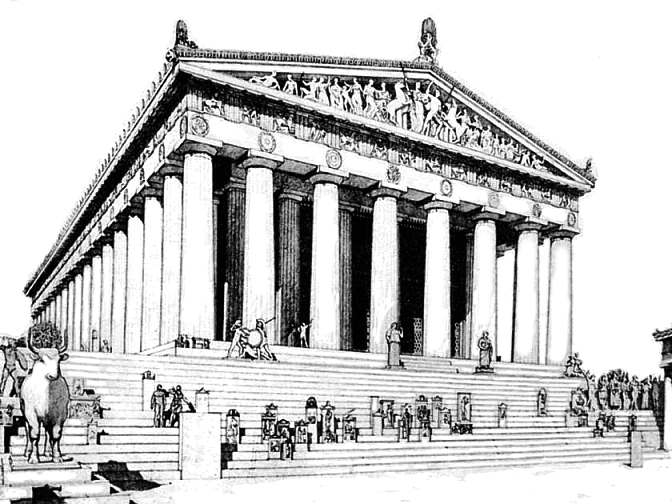 The Greeks have unfluenced how we live and how we build things very much in today's culture. They have invented so many different varieties of buildings that people use today. (ONLINE BOOK 1: wikipedia!)
When the Greeks first started building houses, they were very simple and small. Most of the houses that they built were shaped circular, oval, apsidal, or rectangular. To put together the house, they used mud bricks or stones in the mud with reeds or brush to help. Most of the houses, being small, had only one or two small rooms.
During the classical architectural period for the Greeks, they built in only three orders. These three orders were Doric, Ionic, and Corinthian. These different styles consisted of mostly the columns on the buildings and temples. The Doric style was the simplest one of the three. The comumn is very sturdy and the peak or top of the column is very plain and simple. It is also the widest column of the three. This style was used in mainland Greece and the colonies in southern Italy and Sicily. The Ionic column is the skinniest column of the three. It is a very elegant column that was skinny. The peak was shaped more like a scroll than anything else. The Ionic style column was used mostly in eastern Greece and the islands. The Corinthian style column was the most decorated column of the three. The column in general was very fancy and decorated. The peak of this column was very elaborate and decorated with acanthus leaves. The Corinthian style column was used in the Greek world, but often seen on Roman temples.
"The Parthenon was one of the worlds greatest buildings. Its position is part of its splendor, It has 3 qualities that make it of high quality. It was made from the finest marble, the portions were subtly modified to give an illusion of lightness. The steps were slightly thicker that others and the columns leaned slightly inwards. It was the most richly carved temple ever built. Its sculptures represented the climax of classical revolution in art."(Freeman,Charles.P.258) The Parthenon in Athens is the most famous surviving temples in Ancient Greece. It is also one of the most famous buildings/temples in the world. The Parthenon has been on the Acropolis of Athens for about 2,500 years and was built by the Greeks to give thanks to the city's goddess, Athena. They built the Parthenon to give thanks to Athena for the salvation of Athens and Greece in the Persian Wars. (BOOK SOURCE 2 Freeman, Charles. P. 258)
Some of the buildings and temples that were built by the Greeks were made out of mud and reed, so not many of those stand today. They were not sturdy enough to stand, but today, we have some ground plans that have helped us today to visualize what the temples and buildings looked like before they fell. We have an idea today of what the buildings looked like when they were build of mud and reed.
Book Sources
Book Source 1: WikipediaBook Source 2: Freeman, Charles. Egypt,Greece,and Rome.Civilizations of the Ancient Mediteranean. New York. Oxford University Press. 2004
Saturday, October 27, 2007
Homer's Writings
Homer was, in the eyes of the ancient Greek literature, a very important person. He was the author some of most epic poems from the earlier ages. This blind poet, Homer, lived around the time of the Trojan War in the 12th century BC. nobody really knows where Homer was born, but two of the most famous guesses are Chios or Smyrna.
Homer wrote the Iliad and the Odyssey. the Iliad, a long epic on the wrath of the warrior Achilles, which endangered the Greek expedition to Troy, and the Odyssey, an equally long poem on the difficult voyage home of Odysseus, are very similar. There have been many debates on whether Homer was the actual author of these two great poems because nobody really knew who Homer realyy was, or if he even was."There are over one thousand fragments from Homer, and indication of his immense popularity as a 'classic' throughout the Greek and Roman era."(BOOK ONE! Freeman,Charles, p.5)
Nobody really knows Homer's life story. He is basically only known for his writings and works, but not for anything that he actually physically did, like building something. Homer was even said to have been blind. I find this hard to believe because he wrote long stories(Iliad & Odyssey) that must have taken eyes to write...
The Iliad and the Odyssey, written by Homer, helped shape the Greek civilization. These two epic poems helped shape the Greek civilization because his writings were known as the most important texts inh the Greek culture.
Homer was a very important man to the Greek people because his two epic poems, the Iliad and the Odyssey, talked about Troy. Troy, to some people, didn't exist, until the late 1870's, a man entered Troy and declared that it was real. (BOOK TWO! http://en.wikipedia.org/wiki/Troy)
BOOK ONE! Freeman, Charles. Egypt,Greeceand Rome,Civilizations of the Ancient Mediterranean. Oxford University Press.New York.2004
BOOK TWO(online book) Troy
Homer wrote the Iliad and the Odyssey. the Iliad, a long epic on the wrath of the warrior Achilles, which endangered the Greek expedition to Troy, and the Odyssey, an equally long poem on the difficult voyage home of Odysseus, are very similar. There have been many debates on whether Homer was the actual author of these two great poems because nobody really knew who Homer realyy was, or if he even was."There are over one thousand fragments from Homer, and indication of his immense popularity as a 'classic' throughout the Greek and Roman era."(BOOK ONE! Freeman,Charles, p.5)
Nobody really knows Homer's life story. He is basically only known for his writings and works, but not for anything that he actually physically did, like building something. Homer was even said to have been blind. I find this hard to believe because he wrote long stories(Iliad & Odyssey) that must have taken eyes to write...
The Iliad and the Odyssey, written by Homer, helped shape the Greek civilization. These two epic poems helped shape the Greek civilization because his writings were known as the most important texts inh the Greek culture.
Homer was a very important man to the Greek people because his two epic poems, the Iliad and the Odyssey, talked about Troy. Troy, to some people, didn't exist, until the late 1870's, a man entered Troy and declared that it was real. (BOOK TWO! http://en.wikipedia.org/wiki/Troy)
BOOK ONE! Freeman, Charles. Egypt,Greeceand Rome,Civilizations of the Ancient Mediterranean. Oxford University Press.New York.2004
BOOK TWO(online book) Troy
Saturday, October 6, 2007
New Kingdom
The New Kingdom was from 1550-1295 B.C. This was the time where many different pharaoh's, both men and shockingly, women, laid out many foundations that shaped Egypt into what it is today. In this blog, I will be telling of some of these kings and queens.
One of the first rulers of the New Kingdom was Hatshepsut. Hatshepsut was born into the 18th dynasty. She was daughter of Thuthmose I and Ahmes and after her father died, her brother, Thuthmose II took over the throne. Her brother was much, much younger than she was. Her two bothers died, leaving her to take over the throne. Since she was a female, it was not allowed of her to become pharaoh. Hatshepsut dressed as a man and even told the people of Egypt that she was a man. The Egyptian people believed her and had no problem at all with her becoming pharaoh of Egypt.
While Hatshepsut was pharaoh, she took on several male features while she ruled Egypt. Unlike most women at the time, she attached a false beard, wore male clothing, and was made in statues as a man. She did not want the people of Egypt to know that she was a woman.(What Life Was Like on the Banks of the Nile, page 1)
During Hatshepsut's reign, she had many great acomplishments. One of her greatest accomplishments was the Deir el Bahri. This building was a temple that was dedicated to herself. It was built on the west bank of the Nile at Thebes. At the temple, there are writings on the walls and sphinx's that lead up to the doorway. Also, during Hatshepsut's reign, she sent out military expeditions and sent out a trading expedition to Africa. Hatshepsut died in 1458 B.C.
Another ruler during the New Kingdom was Tutankhamen, also known as King Tut. Not much is known about King Tut's childhood, but when his tomb was found, there were MANY things that were found out about him that nobody knew. Tut's tomb was found on Novermber 4, 1922 in the Valley of the Kings. Up until the discovery of his tomb, it was beilieved that royal tombs were just places that were robbed of all their history and treasures. But Tut's tomb proved them wrong.
Although we do not know alot about Tut's childhood, we do know that he was in charge of the throne at a very young age. Tut's tomb was almost in complete tact. It had been robbed soon after he was placed in his tomb, but everything was put back as soon as possible.
BOOK SOURCE #1
By the editors of the Time Life Books. What Life Was Like on the Banks of the Nile. Alexandria, Virginia. No date.
BOOK SOURCE #2
Wikipedia!
One of the first rulers of the New Kingdom was Hatshepsut. Hatshepsut was born into the 18th dynasty. She was daughter of Thuthmose I and Ahmes and after her father died, her brother, Thuthmose II took over the throne. Her brother was much, much younger than she was. Her two bothers died, leaving her to take over the throne. Since she was a female, it was not allowed of her to become pharaoh. Hatshepsut dressed as a man and even told the people of Egypt that she was a man. The Egyptian people believed her and had no problem at all with her becoming pharaoh of Egypt.
While Hatshepsut was pharaoh, she took on several male features while she ruled Egypt. Unlike most women at the time, she attached a false beard, wore male clothing, and was made in statues as a man. She did not want the people of Egypt to know that she was a woman.(What Life Was Like on the Banks of the Nile, page 1)
During Hatshepsut's reign, she had many great acomplishments. One of her greatest accomplishments was the Deir el Bahri. This building was a temple that was dedicated to herself. It was built on the west bank of the Nile at Thebes. At the temple, there are writings on the walls and sphinx's that lead up to the doorway. Also, during Hatshepsut's reign, she sent out military expeditions and sent out a trading expedition to Africa. Hatshepsut died in 1458 B.C.
Another ruler during the New Kingdom was Tutankhamen, also known as King Tut. Not much is known about King Tut's childhood, but when his tomb was found, there were MANY things that were found out about him that nobody knew. Tut's tomb was found on Novermber 4, 1922 in the Valley of the Kings. Up until the discovery of his tomb, it was beilieved that royal tombs were just places that were robbed of all their history and treasures. But Tut's tomb proved them wrong.
Although we do not know alot about Tut's childhood, we do know that he was in charge of the throne at a very young age. Tut's tomb was almost in complete tact. It had been robbed soon after he was placed in his tomb, but everything was put back as soon as possible.
BOOK SOURCE #1
By the editors of the Time Life Books. What Life Was Like on the Banks of the Nile. Alexandria, Virginia. No date.
BOOK SOURCE #2
Wikipedia!
Friday, September 28, 2007
Egypt's Middle Kingdom
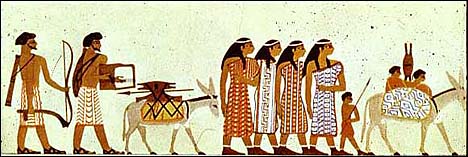 The 11th dynasty marks the beginning of the Middle Kingdom. This dynasty lasted from 2040 to 1640 B.C. The Middle Kingdom was the start of many new things to the Egyptians. Some of these things included trade, arts, and the literature expanded majorly.
During the Middle Kingdom, there were many kings that ruled the throne. the first known ruler is known to be a man named Nebhetepre Mentuhotep I. Mentuhotep I ruled for about 51 years on the throne. Before Mentuhotep I, Upper and Lower Egypt were ruled by seperate rulers, but then Mentuhotep came around and meshed them into one. He brought great stability to Egypt. "The Middle Kingdom is when the country flourished again as it did in the Old Kingdom". (David, Rosalie.Pg.29 BOOK SOURCE ONE)
Egypt's Middle Kingdom is known as the Golden Age. This is the time where trade, arts, and literature became big and well known. It was also a time where Egypt trained and built up strong armies to defend themselves from their neighbors. During the Middle Kingdom, the kings and pharaoh's were supposed to be grand and very smart. They were to expected to be good to their people and fair to all people also. After the kings or pharaoh's died, they were placed into their tombs where they would then, as they believed, enter the after-life that was filled with wealth or joy or poor-ness and sorrow. It was either a very good or a very bad place.
During the Middle Kingdom, there were many pyramids that were built. Most of the pyramids that are still standing today were built in the old and middle kingdoms. Amenemhet III seemed to be the last powerful pharaoh of the 12th Dynasty. During his reign, he built the first pyramid at Dahshur. The pyramid that he had built was called the Black Pyramid. This pyramid was 272 feet high, 350 feet wide, and had an incline of 57 degrees. The pyramid consists of unburned bricks and clay. Today, the pyramids odd shape stands out in the vast desert.
Since most of the pyramids still standing today were built in the time of the Middle Kingdom, this must mean that they were built very strong and ready for anything to come. When the pyramids were built, they were actually so smooth that they kind of shined. Today, the pyramids are all jagged and messed up because over time, people from the outside cities have come in and stolen some of the stones that they used and used them on another building. And yet they have gotten through all of this and are still standing today.
BOOK SOURCE #1
Rosalie, David. Handbook to Life in Ancient Egypt. New York. Oxford University Press. 1998
BOOK SOURCE #2 ONLINE BOOK!
http://en.wikipedia.org/wiki/Amenemhet_III
Thursday, September 20, 2007
Old Kingdom
The Old Kingdom in Egypt was actually the time period of the dynasties one through six (3100-2890 B.C. to 2181-2125 B.C.). In the next few paragraphs, I'm going to be explaining each dynasty thoroughly.
The First Dynasty was from 3100-2890 B.C. But before the first dynasty, Egypt was actually two separate lands. It is told that King Menes was the man who joined these two lands called Upper and Lower Egypt. To keep Egypt under control, there had to be one man that would basically control EVERYTHING. When the King gained enough power, the people called him "Pharaoh." The pharaoh thought of himself to even be part god! CRAZY! Since the pharaoh had so much to do, he had family members and important people help him out wit his tasks. The First Dynasty is also the time where the Egyptians started to use papyrus. This helped them record important things that were happening that that time and write down what we are learning in history today.
The Second Dynasty was from 2890-2686 B.C. At the end of the First Dynasty, there was arguments over who was going to rule Egypt. The feud was never really resolved and toward the end of the dynasty, there seemed to have been more disorder and possibly civil war.
The Third Dynasty was from 2686-2613 B.C. This particular dynasty marks history. This dynasty is the one where the first actual monumental building is built; the Pyramid. But these pyramids were weakly constructed and not as good as those you will see in the fourth dynasty.
The Fourth Dynasty was from 2613 2494 B.C. The pyramids in this dynasty were constructed very good. The Pyramids at Giza were built during the fourth Dynasty and are one of today's most visited sites in Egypt.
The Fifth Dynasty was from 2494 2345 B.C. During this period, many people ruled Egypt. There was around nine rulers that ruled Egypt. When the rulers would die, they were put into tombs. The tombs were inside of the pyramids and these tombs were grand.
The Sixth Dynasty was from 2345-2181 B.C. The sixth dynasty includes records of trading expeditions to the south from the reigns of Pepi I.
The First Dynasty was from 3100-2890 B.C. But before the first dynasty, Egypt was actually two separate lands. It is told that King Menes was the man who joined these two lands called Upper and Lower Egypt. To keep Egypt under control, there had to be one man that would basically control EVERYTHING. When the King gained enough power, the people called him "Pharaoh." The pharaoh thought of himself to even be part god! CRAZY! Since the pharaoh had so much to do, he had family members and important people help him out wit his tasks. The First Dynasty is also the time where the Egyptians started to use papyrus. This helped them record important things that were happening that that time and write down what we are learning in history today.
The Second Dynasty was from 2890-2686 B.C. At the end of the First Dynasty, there was arguments over who was going to rule Egypt. The feud was never really resolved and toward the end of the dynasty, there seemed to have been more disorder and possibly civil war.
The Third Dynasty was from 2686-2613 B.C. This particular dynasty marks history. This dynasty is the one where the first actual monumental building is built; the Pyramid. But these pyramids were weakly constructed and not as good as those you will see in the fourth dynasty.
The Fourth Dynasty was from 2613 2494 B.C. The pyramids in this dynasty were constructed very good. The Pyramids at Giza were built during the fourth Dynasty and are one of today's most visited sites in Egypt.
The Fifth Dynasty was from 2494 2345 B.C. During this period, many people ruled Egypt. There was around nine rulers that ruled Egypt. When the rulers would die, they were put into tombs. The tombs were inside of the pyramids and these tombs were grand.
The Sixth Dynasty was from 2345-2181 B.C. The sixth dynasty includes records of trading expeditions to the south from the reigns of Pepi I.
Subscribe to:
Posts (Atom)


